

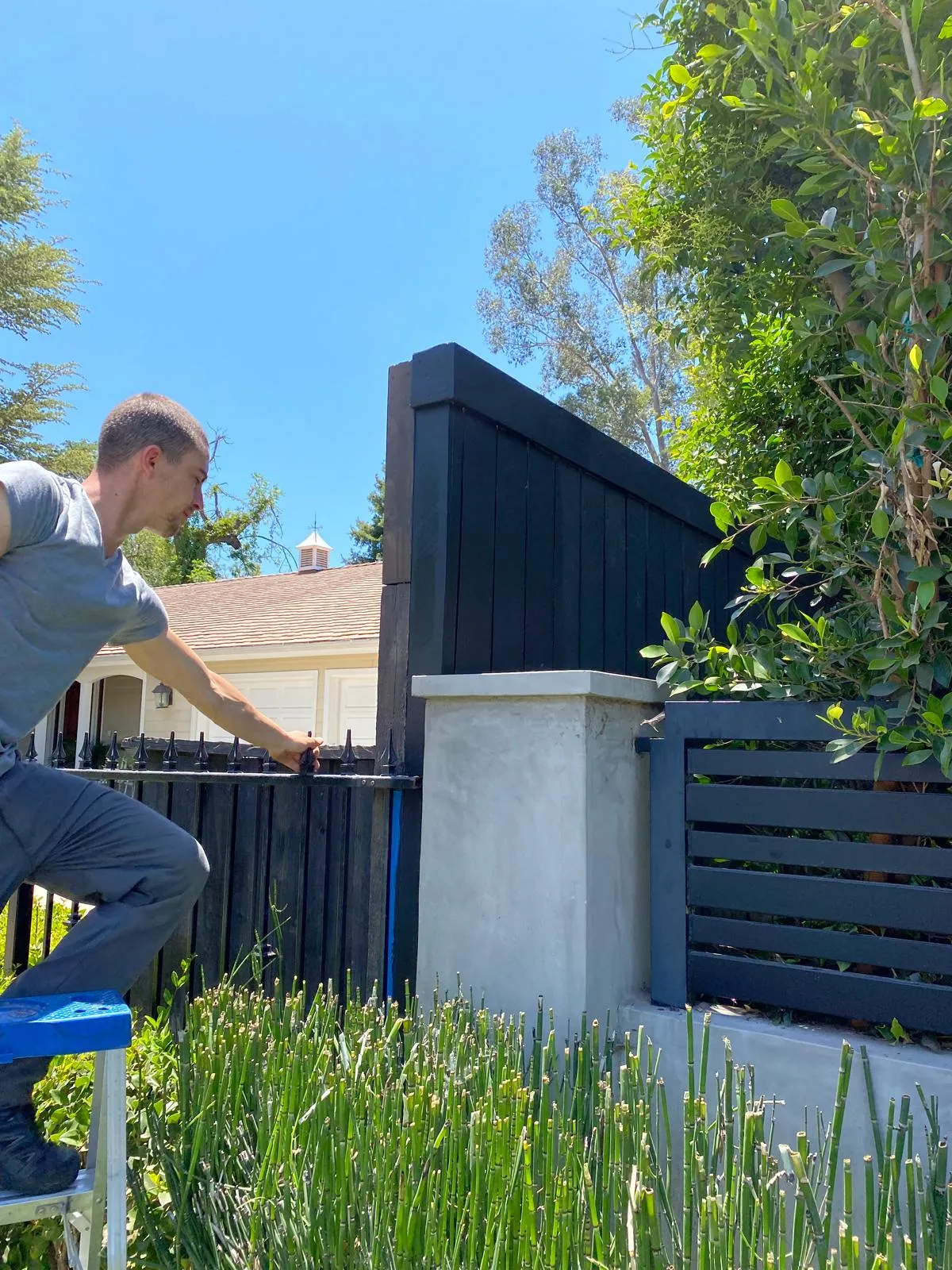
Underground vs. articulated arm vs. surface-mounted swing gate operators
Three ways to mount a swing operator. Each asks something different of the site.
A swing gate operator can sit underground below the hinge, on an articulated arm bolted to the pillar, or as a linear actuator running from the post to the gate. All three move the same kind of gate. What separates them is what each needs from the site: drainage for an underground box, pillar room for an articulated arm, and tight hinge geometry for a linear actuator.
01The short answer
- Underground: for gates that must look untouched, on ground that drains well. The box needs a drain, and the hinges must line up with the box pivot.
- Articulated arm: for wide pillars, with the operator kept above ground where it stays dry and is easy to service.
- Surface-mounted linear actuator: for gates hung on narrower posts, as long as the hinge sits close to the post edge and the mounting dimensions fit the manufacturer's limits.
02Side by side
Figures are from the manuals named in each cell. Your operator's own manual sets its limits.
03Underground operators
An underground operator sits in a foundation box set into the driveway at the hinge, so the gate looks the same automated as it did by hand. DoorKing says the box must have a drain pipe with the correct slope, because standing water will eventually make the operator fail, and that the box must be level and flush with the driveway. FAAC, BFT and CAME all call for drainage from their boxes too.
Designs differ in how the leaf is carried. DoorKing's 6400 requires the gate to hang on its own hinges, not rest on the operator, with the hinge pivots lined up on the box pivot. FAAC's 770N carries the leaf on a support frame in the box and keeps only the upper hinge. Either way, the box and the hinges have to line up exactly.
04Articulated-arm operators
An articulated arm bolts to the face of the pillar and folds as the gate swings. FAAC's 390 is made for large columns, and FAAC publishes tables of how far the base plate can sit from the hinge for 90° and 120° openings. Its twin-arm 391 is designed for very large pilasters, with up to 200 mm between the hinge and the operator's fixing point.
Because the operator is above ground, it stays dry and is easy to reach. The trade-off is that it shows on the pillar, and the pillar has to be wide and solid enough to take the plate within the maker's dimensions.
05Surface-mounted linear actuators
A linear actuator is a screw-driven arm that runs from a bracket on the post to a bracket on the gate, and it is the most sensitive of the three to geometry. LiftMaster's LA400UL manual calls for no more than 4 inches from the center of the hinge to the edge of the post, or entrapment protection in that area, an A plus B of no more than 15 inches, an opening of no more than 100°, and a mounting at least 12 inches off the ground.
The LA400UL ships to pull the gate open; a gate that pushes open needs a push-to-open bracket. Several linear actuators run from 12V or 24V batteries charged by AC or solar, which suits gates a long way from a power supply. LiftMaster says not to install its solar LA412UL on uphill or downhill gates.
06Which to choose
Start with the site, not the operator. If water collects at the hinge or the drive is heavily planted, rule out underground. If the pillars are narrow, rule out an articulated arm. If the hinge sits more than 4 inches back from the post edge, a linear actuator needs entrapment protection in that area. What is left usually points to one type, and the weight and length of the leaf then pick the model.
07Repair pages for these operators
08Questions buyers ask
Which swing gate operator is least visible?
An underground operator. The motor sits in a foundation box below the hinge, so only the box cover shows at ground level. An articulated arm shows on the pillar, and a linear actuator shows between the post and the gate.
Do underground gate operators flood?
They can, if the foundation box does not drain. DoorKing warns that poor drainage leaves stagnant water that eventually makes the operator fail, and FAAC, BFT and CAME all call for drainage from the box. Sites where water collects are better served by an above-ground operator.
Can a linear actuator fit any swing gate?
No. It depends on the hinge position and the post. LiftMaster's LA400UL, for example, needs the hinge within 4 inches of the post edge, or entrapment protection in that area, and A and B dimensions that add up to 15 inches or less, and LiftMaster says not to install its LA412UL on uphill or downhill gates.
Can I switch from an underground operator to a surface-mounted one?
Usually, yes. A surface-mounted or articulated-arm operator can replace an underground one when the box keeps flooding or the gearmotor has failed, as long as the pillars, hinges and leaf suit the new operator. We check those on site before quoting.
Who installs and repairs swing gate operators near me?
Veritas Access Solutions installs and repairs underground, articulated-arm and linear-actuator swing gate operators across Los Angeles, Ventura and Kern counties, including gates another company installed. We give you a written diagnosis before any work. Call 661-605-3266, or text a photo of the operator and we call back within 30 minutes during business hours.
09Sources
Specifications and requirements in this guide come from these documents. Check your own operator's manual before relying on a figure, because ratings change between versions.
- DoorKing 6400 installation manual 6400-065-R-9-24
- FAAC 770N installation manual 732615 (manual library copy)
- FAAC 390 US manual 732669 Rev. G
- FAAC 391 installation manual (manual library copy)
- LiftMaster LA400UL installation manual
- LiftMaster LA412UL installation manual 114-5673-000 (distributor copy)
- BFT ELI 250 BT installation manual (manual library copy)
- CAME FROG-CF / CFI foundation box instructions FA00604M4A
- Nice CBOX936 manual MX4683 (Apollo 1550 with 816 actuator)
- US Automatic Patriot manual, board 500018